AI Didn't Break Education. It Exposed It.
When a machine can produce the paper, the paper can no longer be our best proof of learning. The opportunity is not to eliminate AI. It is to bring education back to the thinking person.
See the workshops
"In the AI era, the paper is evidence of preparation. The conversation is evidence of understanding."
From Voice to Paper — and Back?
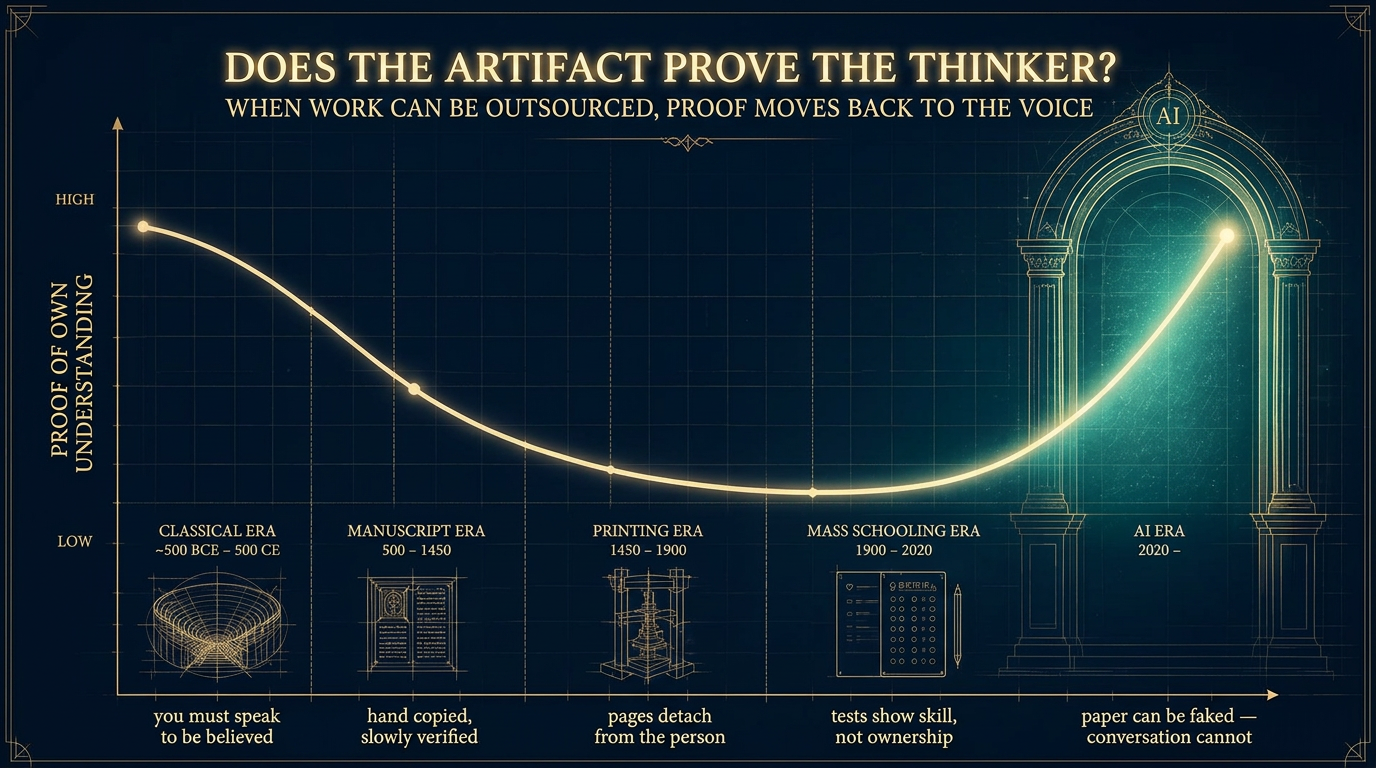
For centuries, the evidence of education changed with our tools. We moved from public reasoning, to manuscripts, to cheap writing, to mass testing. Now AI can manufacture the artifact schools learned to measure.
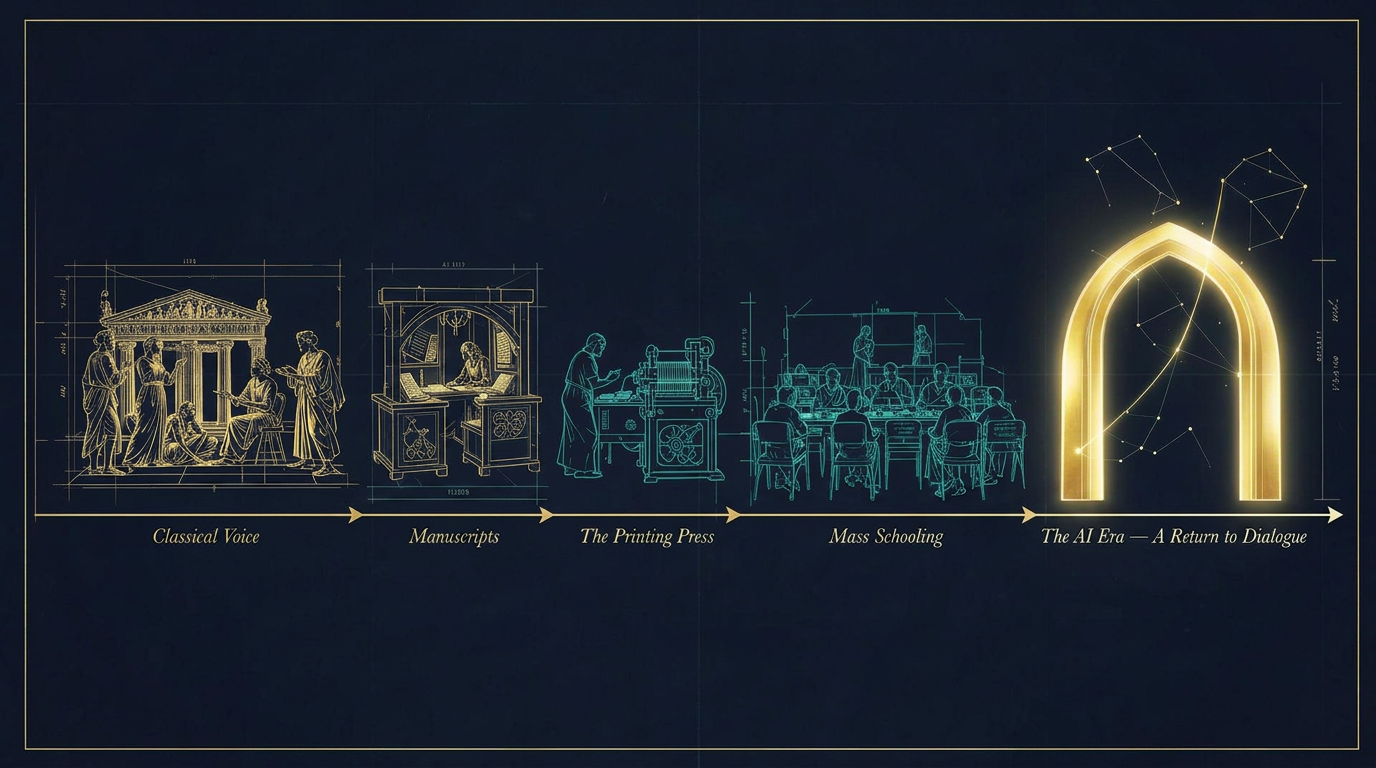
Education began as the formation of people who could remember, reason, speak, and act. Somewhere along the way, we began mistaking the artifact for the mind.
Grammar gave students knowledge. Logic taught them to question and organize it. Rhetoric required them to communicate, defend, and use it. The Quadrivium trained the eye to recognize number, proportion, harmony, and order.
Written assignments, tests, grades, transcripts, and credentials made learning easier to collect and compare. A student could look highly educated on paper without often being asked to explain an idea aloud or withstand an unscripted question.
If AI can produce the essay, worksheet, summary, or slide deck, possession of that product does not establish intellectual ownership. We have to encounter the learner again.
Don't Remove the Struggle. Create Better Struggle.
Ask it to teach through questions, reveal misconceptions, and adjust the explanation — without supplying the final answer.
Try: "Ask me one question at a time until you can identify what I misunderstand."

Let it take the other side, test an argument, surface missing evidence, and prepare the learner for real human dialogue.
Try: "Challenge my position. Don't improve it for me; make me defend it."

Protect private information, check claims against trustworthy sources, disclose meaningful AI help, and require the learner to explain every conclusion.
Try: "Never submit what you cannot explain, verify, and defend."
Stop Fearing the Tool. Learn to Use It With Purpose.
Jennifer's practical workshops help educators, founders, families, and teams move from casual AI prompting to safe, thoughtful, real-world use — by building real things together.
Drop in for one build, or join the full summer series.
Get the Free AI Guide